Can I Eat All My Calories for the Day in One Meal and Still Lose Weight?
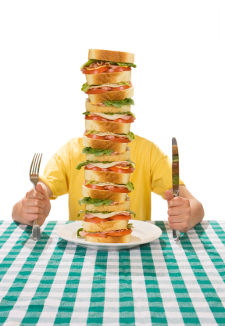
You hear it everywhere now: if you want to lose weight, it helps to eat smaller meals more frequently. In other words, spread out the calories (energy) you take in over the course of day instead of eating all those calories in one sitting. This helps to keep your blood sugar level and curb cravings, amongst others.
Now, eating small meals more frequently doesn’t mean you are automatically going to lose weight. You still need to be within a calorie deficit: to lose weight, you need to eat less calories than you burn in a day. So, let’s say you eat 1500 calories and you burn 2000 calories in a day. That creates a reasonable calorie deficit of 500 calories. But a lot of people skip breakfast, forget about lunch and figure they’ll just eat a big supper. So, the question is: doesn’t it all come out to the same thing, no matter when you eat those calories? If you don’t eat all day long, won’t your body burn calories by using up your extra body fat? And if you eat a lot of calories at the end of the day, won’t your body just replace the fat that was burned during the day? And if you’re still eating at a calorie deficit, won’t you lose weight anyway, no matter when you eat those calories?
See: Creating a Healthy Eating Schedule for Weight Loss
Over at the Burn the Fat Inner Circle, Tom Venuto interviewed Dr. Dan Benardot on that very same question. You need to be a paying member to read the full article, so I thought I’d summarize it for you. Here’s why you need to eat smaller meals more frequently:
Real-Time Energy Balance
When it comes to calories, our body doesn’t look at a 24 hour period. It’s not like midnight arrives and our body, tongue sticking out, calculator in hand, begins calculating what we ate. “Okay, let’s see, that’s a total of 1572 calories today. And, yes, we did move a lot today and burned 2000 calories overall. Whoohoo, let’s burn some fat!”
See: How Many Calories Do Your Burn in a Day?
Instead, your body assesses your needs in “real-time”, as it happens. To quote Dr. Benardot, in the article: “Much like you can’t provide all the fuel your car needs for a 1000-mile trip at one time, you can’t provide all the fuel your body needs for a day at one time.”
Your body is constantly working and needs its energy needs met throughout the day to avoid causing problems.
Eating Nothing and Then Overeating Causes Problems—Even If You’re In a Calorie Deficit
Because your body can only handle so much energy in one sitting (just like you can’t overfill your gas tank for 1,000 mile trip) hardly eating anything all day and then eating most of your calories in one sitting can cause problems:
- Your blood sugar levels fluctuate instead of holding steady, which can result in a loss of lean body mass. In other words, it’s not fat that’s being lost but potentially muscle. And we don’t want to lose muscle. Lowering your lean body mass means your body burns less calories. Not good.
- Eating when your blood sugar is low (because you’ve hardly eaten anything all day) causes you to release more insulin—which means more fat is produced.
You then get into a vicious cycle of your body losing lean body mass, producing more fat, and burning less calories.
See: How To Repair A Damaged Metabolism
What You’re doing to Your Fat Cells
Another important point Dr. Benardot makes is that overeating increases the size of your fat cells and you can even make more fat cells. “Once this happens, it’s extremely difficult to reverse the fat-cell enlargement. “
The Solution: Within Day Energy Balance
It’s better to keep your energy balanced by staying within a range of calories through the day, making sure not to overeat AND to not create a huge calorie deficit through a lack of food. Eating more than 300 to 400 calories in a meal will likely cause a surplus of energy. Creating a calorie deficit of 300 to 400 calories will cause the problems mentioned up above (depending on your body size). For example, if your body needs 300 calories in a three hour period, and you’re not feeding it more calories after that three hour period is up, your body is going to start looking for energy in your lean body mass.
See: 3 Reasons Why Eating Less Than 1000 Calories is a Waste of Time
Bottom line, if you want to keep your body running efficiently, like a well-tuned car, you need to give it what it needs at the time that it needs it. No more, no less.
See: A Daily Eating Plan For Weight Loss
To read the original interview, “Within Day Energy Balance and Meal Frequency,” you’ll need to be a member of the Burn The Fat Inner Circle. Get SIX MONTHS FREE membership when you buy Tom Venuto's Burn the Fat 7 Day Transformation Program.
Related FitWatch Calculators
Calories Deficit Calculator
Calories Per Meal Calculator

Suzanne Hiscock is a PN L2 Certified Master Coach, ACE-certified Health Coach, as well as an ACE-certified Fitness Nutrition Specialist. For over 20 years, she's been helping people lose weight and get fit through her website, FitWatch.com.
And she’s really TRULY SORRY ABOUT THAT. You see, she didn’t realize she was contributing to diet culture; she just wanted to help people feel better. But losing weight isn’t the way to do it. She’s on a mission to change all that with an anti-diet approach. So, pardon the dust on the floor as the website gets revamped.