Weight Loss: How Much Should I Weigh?
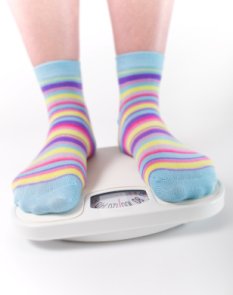
How much should I weigh? It’s a common question posed by people of all ages. Some experts say that you should stick to whatever weight is comfortable for you. Perhaps you’ve met people who are quite content at their current weight, even though they are thin or heavy.
There are slim people who feel uncomfortable when they develop the slightest belly. There are obese people who are quite content carrying around all that extra weight.
Perhaps a better question than ‘How much should I weigh’ would be ‘What is a healthy weight for me?’.
One quick way to find out is through weight charts. Your local community health center should be able to provide you with this chart. The basic chart goes by age, height and bone structure (also referred to as frame size). If you are small-boned (small frame) and 5’8”, your best weight would be considerably less than someone of the same height who is large-boned.
If you’re trying to lose or gain weight, it’s best to avoid weight fluctuations. You’re not alone if you’ve experienced the challenge of losing or gaining just the right amount of weight, and then staying there. Doctors say that it’s less healthy to be losing and gaining weight than it is to stay at a heavier weight.
‘How much should I weigh?’ is a great question for your doctor because he is in a much better position to advise you than by just checking a chart. There are several things to consider, including whether you are healthy at your current weight and if it can cause you problems in the future. Another method is to check your Body Mass Index (BMI), which compares your height to your weight. The resulting equation will tell you how much you should weigh. Chances are, you can be perfectly safe at 10-20 pounds or more over your suggested weight.
This is especially true if you are developing muscle, because by volume, muscle weighs more than fat. Plus, people with good muscle development are generally healthier than people who are carrying around excess fat.
Next time you ask, ‘how much should I weigh?’, look at all the variables including body frame, BMI, and muscle structure.
The biggest concern is not about weight. It’s more directly related to excess fat in the body, which is one of the major risk factors for disease. Your local fitness center or health clinic can check your body fat with a pair of skin-fold callipers or other devices. These painless measurements are taken at different locations on your body.
Or you can measure your body fat in the privacy of your own home using Accu-Measure calipers—read my review here: Accu-Measure Body Fat Calipers Review.
Think carefully about who you rely on to determine how much you should weigh because what’s good for one person is not necessarily suitable for another. As you can see, there are certain differences to take into account.
If you’re 150 lbs., 5’6”, medium framed and muscular, in all likelihood you will be much healthier and in better shape than your friend who is the same weight, height and bone size, but carrying excess fat.
Talk to your doctor to most accurately determine how much you should weigh.
Must ReadHow to Set a Weight Loss Goal
How to Count Calories

FitWatch makes weight loss simple by doing all the counting for you and giving you down-to-earth weight loss information, tips and tricks you can actually use in your everyday life to lose weight and get fit. Eat better, move more and believe in yourself with FitWatch! Start exploring FitWatch. Follow us on Google+