How To Read Nutrition Fact Labels
The purpose of it is to help consumers like you make better nutrition decisions. When people can see the number of calories, carbs, sodium, etc. in food, they should be able to eat better, right?
While as a nutrition coach, my job would be to guide you towards clean eating of whole foods and move you away from processed foods, reading nutrition facts labels is still an important skill to have when it comes to losing weigh and eating healthy.
So, here’s my four-step crash course on reading the Nutrition Facts label to help you understand what it all means.
Step 1: Look at the Serving Size
The absolute most important part of the food label is to note the serving size. Manufacturers often strategically choose the serving size to make the rest of the label look good. Small serving = small calories/fat/carbs. So, it's tricky.All the information in the label rests on the amount chosen as the serving size. And, since every manufacturer chooses their own, it’s often difficult to compare two products.
In Canada, in the next few years (between 2017-2022), serving sizes will be more consistent between similar foods. This will make it easier to compare foods. The new labels will also have more realistic serving sizes to reflect the amount that people eat in one sitting, and not be artificially small.
Let’s use an example - plain, unsalted walnuts from Costco.
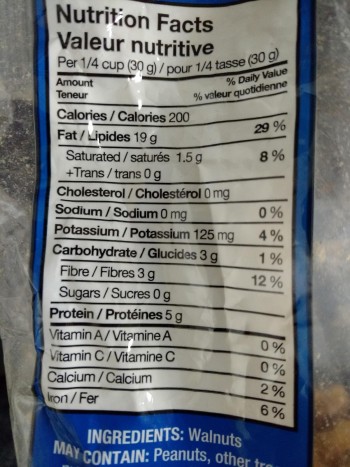
As you can see, right under the Nutrition Facts header is the serving size. That is a ¼ cup or 30 g. This means that all the numbers underneath it are based on this amount.
See: What Is a Serving Size?
FUN EXPERIMENT: Try using a measuring cup to see exactly how much of a certain food equals one serving. You may be surprised at how small it is (imagine a ¼ cup of walnuts).
Step 2: Look at the % Daily Value
The % Daily Value (%DV) is based on the recommended daily amount (RDA) of each nutrient the average adult needs. Ideally, you will get 100% DV for each nutrient every day. This is added up based on all of the foods and drinks you have throughout the day.
NOTE: Since children are smaller and have different nutritional needs if a type of food is intended solely for children under the age of 4, then those foods use a child’s average nutrition needs for the %DV.
The %DV is a guideline, not a rigid rule.
You don’t need to add all of your %DV up for everything you eat all day. Instead, think of anything 5% or less to be a little; and, anything 15% or more to be a lot.
NOTE: Not every nutrient has a %DV. You can see it's missing for things like cholesterol, sugar, and protein. This is because there isn't an agreed "official" %DV for that nutrient. The good news is that the new Nutrition Facts labels will include a %DV for sugar. Keep your eyes out for that.
Step 3: Look at the Middle of the Label (e.g. Calories, fat, cholesterol, sodium, potassium, carbohydrates, and protein)
Calories are pretty straight forward. Here, a ¼ cup (30 g) of walnuts has 200 calories.Fat is bolded for a reason. That 19 g of fat (29% DV) is total fat. That includes the non-bolded items underneath it. Here, 19 g of total fat includes 1.5 g saturated fat, (19 g - 1.5 g = 17.5 g) unsaturated fat, and 0 g trans fat. (Yes, unsaturated fats including mono- and poly-unsaturated are not on the label, so you need to do a quick subtraction).
Cholesterol, sodium, and potassium are all measured in mg. Ideally, aim for around 100% of potassium and sodium each day. It's easy to overdo sodium, especially if you grab pre-made, restaurant foods, or snacks. Keep an eye on this number if sodium can be a problem for you (e.g. if your doctor mentioned it, if you have high blood pressure or kidney problems, etc.).
Carbohydrate, like fat, is bolded because it is total carbohydrates. It includes the non-bolded items underneath it like fiber, sugar, and starch (not shown). Here, 30 g of walnuts contain 3 g of carbohydrates; that 3 g are all fiber. There is no sugar or starch. And as you can see, 3 g of fiber is 12% of your daily value for fiber.
Proteins, like calories, are pretty straight forward as well. Here, a ¼ cup (30 g) of walnuts contains 5 g of protein.
See: What Percentage of Carb, Protein And Fat Should I Be Eating?
Step 4: Look at the Bottom of the Label (e.g. vitamins & minerals)
The vitamins and minerals listed at the bottom of the label are also straightforward. The new labels will list potassium, calcium, and iron. Yes, potassium will drop from the middle of the label to the bottom, and both vitamins A & C will become optional.Manufacturers can add other vitamins and minerals to the bottom of their Nutrition Facts label (this is optional). And you'll notice that some foods contain a lot more vitamins and minerals than others do.
I hope this crash course in the Nutrition Facts label was helpful. Like I said, in an ideal world, it's better to eat whole foods that don't come processed or in packages. But reading the nutrition facts label is an important part of figuring out what to eat -- and how much to eat -- to lose weight and eat healthy.
See: Use Hand-Size Portions to Lose Weight and Eat Healthy
References:
http://www.healthycanadians.gc.ca/eating-nutrition/label-etiquetage/changes-modifications-eng.php
https://www.canada.ca/en/health-canada/services/understanding-food-labels/percent-daily-value.html
http://www.healthycanadians.gc.ca/eating-nutrition/label-etiquetage/regulatory-guidance-directives-reglementaires/daily-values-valeurs-quotidiennes/guide-eng.php#p1
Related Articles
Are Your Liquid Calories Making You Gain Weight?
Vitamins & Minerals Calculator
The Elements of Weight Loss

Suzanne Hiscock is a PN L2 Certified Master Coach, ACE-certified Health Coach, as well as an ACE-certified Fitness Nutrition Specialist. For over 20 years, she's been helping people lose weight and get fit through her website, FitWatch.com.
And she’s really TRULY SORRY ABOUT THAT. You see, she didn’t realize she was contributing to diet culture; she just wanted to help people feel better. But losing weight isn’t the way to do it. She’s on a mission to change all that with an anti-diet approach. So, pardon the dust on the floor as the website gets revamped.